
OcuRegen™
A topical bioelectric therapy for faster wound closure.
PCED beachhead. PD-gated development. Lead nomination and in vivo proof-of-concept.

Target indication: Persistent Corneal Epithelial Defects (PCED)
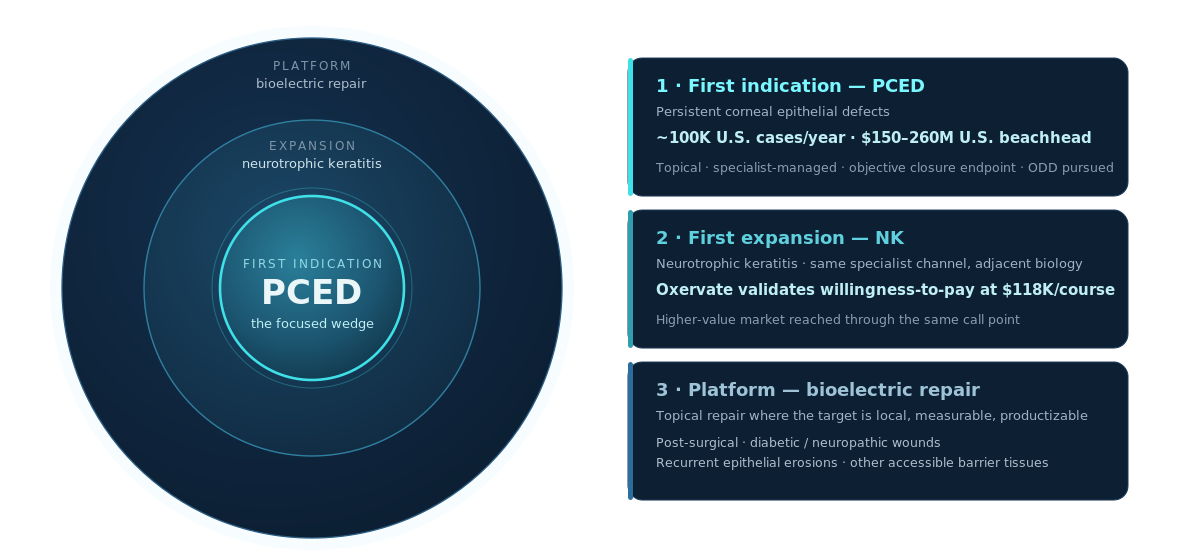
PCED: a corneal surface wound open 2+ weeks despite standard care. ~100,000/year (U.S.), orphan-sized. Objective endpoint: complete closure by fluorescein imaging. Estimated U.S. beachhead: $150–260M. Expansion into neurotrophic keratitis is supported by Oxervate's ~$118K-per-course willingness-to-pay.
Product: OcuRegen™ topical bioelectric modulators
OcuRegen™ candidates are designed to amplify the cornea's own wound-repair current while preserving barrier integrity; restoring the wound's electric field and speeding directional migration toward the injury. A candidate advances only when it produces a pre-specified pharmacodynamic shift, and that shift travels with faster closure.

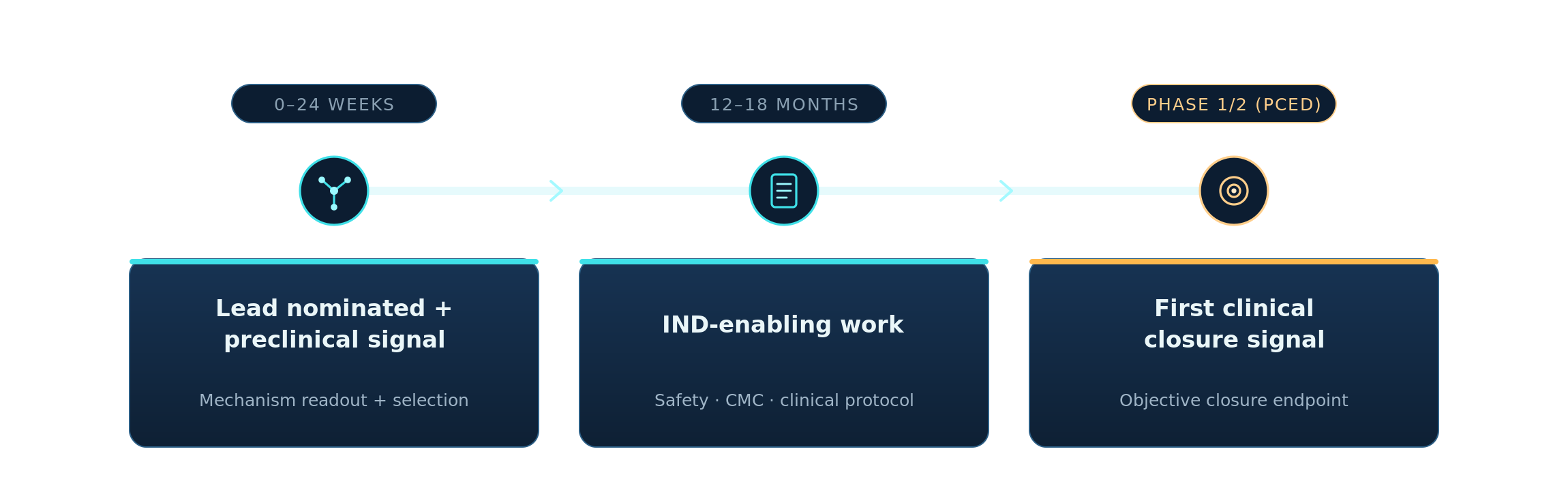
PCED enables short trials with objective epithelial closure endpoints. We plan to pursue Orphan Drug and Fast Track while building mechanistic PD→closure linkage and preparing IND‑enabling work post‑seed.
Clinical & regulatory path
Wedge & expansion
PCED is the beachhead, followed by expansion into neurotrophic keratitis (NK) and broader impaired-healing surface indications, leveraging the same approach.

Differentiation
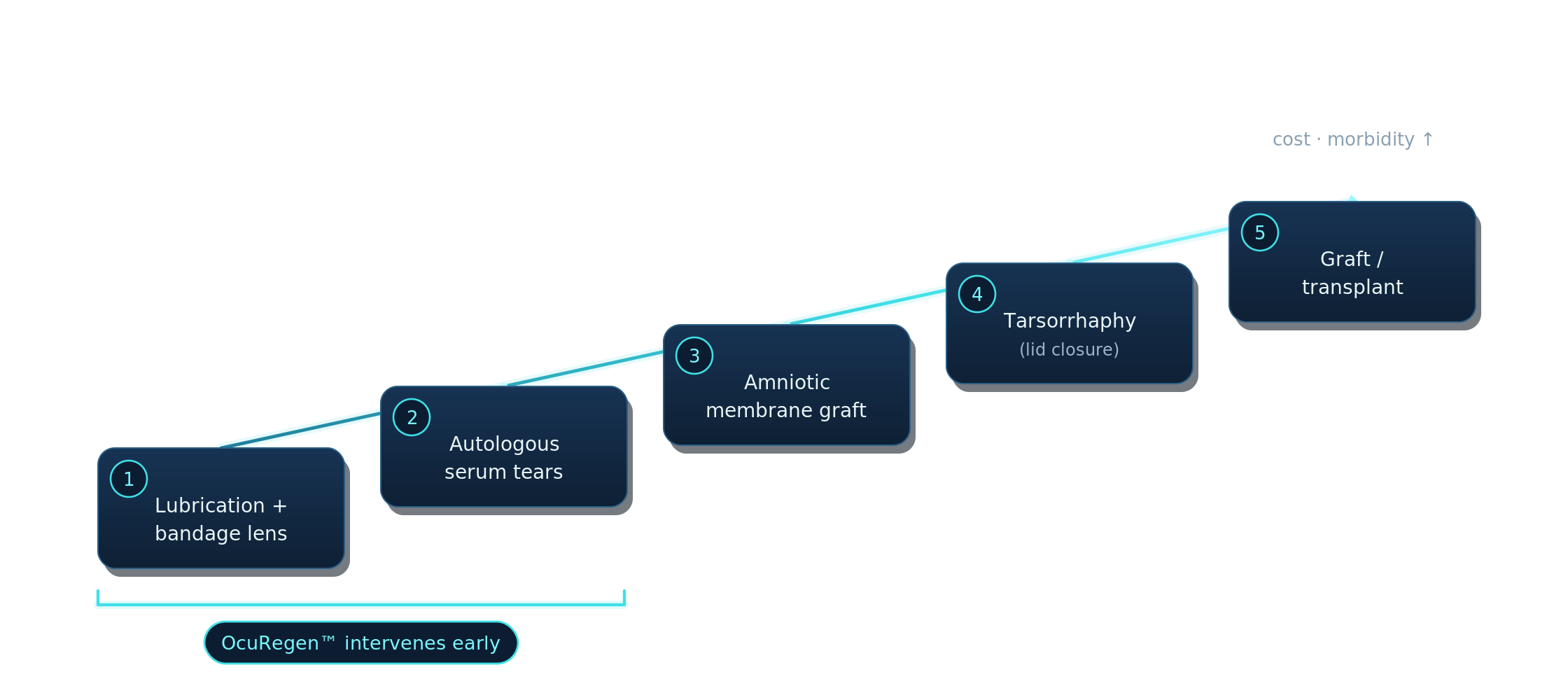
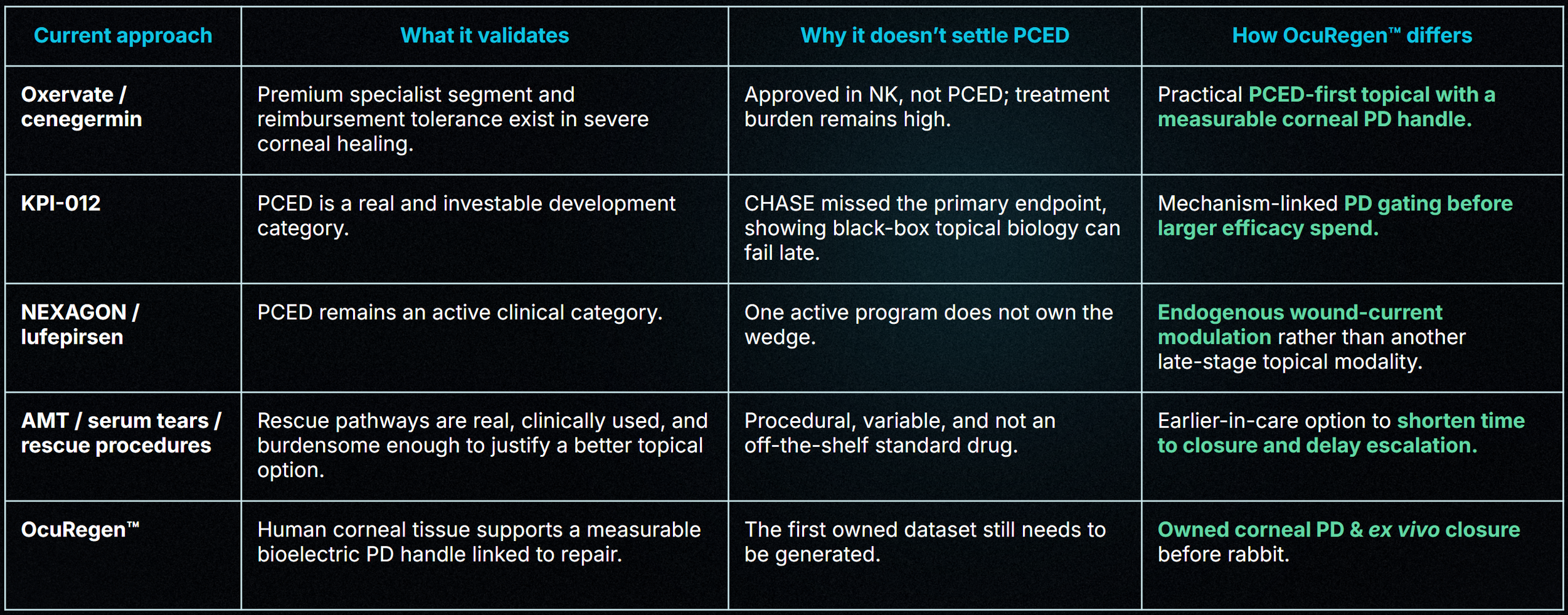
No therapy is approved for PCED across its underlying causes. Each current option carries a structural drawback that OcuRegen™ is positioned against.
Cenegermin (Oxervate®, rhNGF) is approved only for neurotrophic keratitis. It is dosed six times a day for eight weeks, costs more than $100,000 per course, and requires refrigeration and pipette administration. OcuRegen™ is designed as a simple preservative-free eye drop that targets the bioelectric closure mechanism and is meant to be used alongside existing care.
Amniotic membrane (Prokera®/BioTissue, AmbioDisk®/IOP, MiMedx) works but is procedural, facility- and logistics-dependent, and reimbursement-driven. OcuRegen™ is topical pharmacology, with no implant, electrode, graft, or procedure.
Autologous serum tears are blood-derived, non-standardized, and not a commercial product. OcuRegen™ is a defined, manufacturable small-molecule formulation.
In short: a topical, hardware-free modulator with an objective, imageable endpoint (fluorescein closure) and a PD-gated development path, designed to fit alongside current care and shorten time-to-closure.
What this round must prove and how we plan to protect the program
This round is built to answer one question: can a topical candidate move the repair signal and improve closure, well enough to justify a seed round?
Proof points:
A reproducible, decision-useful pharmacodynamic signal in human-relevant tissue.
That signal translating into faster closure across models.
Preserved barrier function and local tolerability.
A protectable, differentiated lead package.
Protection. Composition, formulation, method-of-use, and assay know-how are covered by a staged provisional-filing and freedom-to-operate program. Regulatory: PCED has precedent for Orphan Drug and Fast Track designation; we intend to pursue both. Full IP, FTO, and methodology detail is available under NDA.
Get the investor package
Request the deck and one pager or reach out directly to discuss diligence and collaboration.